DOT Drug Testing Programs for Small Fleets: What Needs to Be in Place
Running a fleet of 60 drivers or fewer does not exempt you from the full weight of DOT drug and alcohol testing requirements. The regulations that govern CDL drivers under 49 CFR Parts 40 and 382 apply regardless of fleet size — and the consequences for non-compliance fall just as hard on a five-truck operation as they do on a regional carrier with hundreds of drivers.
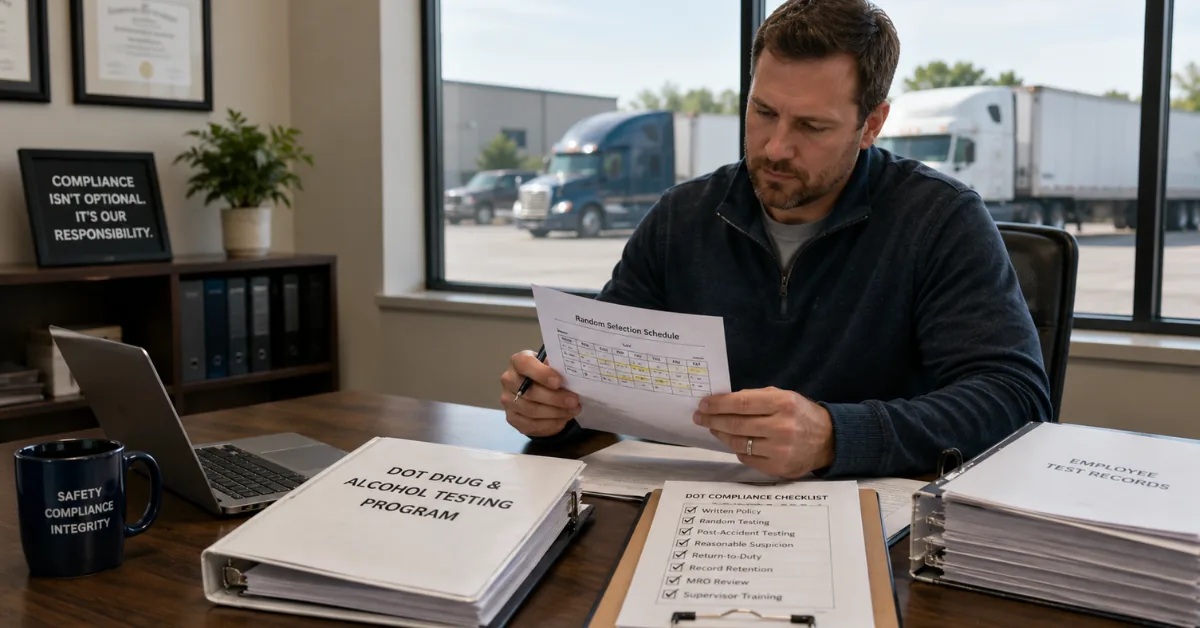
What does change for small fleets is the operational challenge. A large carrier has a dedicated safety director, an HR team, and an established relationship with a third-party administrator. A small fleet owner is often managing compliance alongside dispatch, maintenance, billing, and everything else. That’s where programs get incomplete, records get missed, and audits get expensive.
If your current TPA isn’t making compliance straightforward — or if you’re not sure your program has everything it needs — this is a practical overview of what federal regulations require and what a well-run program actually looks like.
Who Is Covered
FMCSA’s drug and alcohol testing requirements under 49 CFR Part 382 apply to any employer who operates commercial motor vehicles requiring a CDL in interstate commerce. If your drivers hold a CDL and operate vehicles with a GVWR of 26,001 pounds or more, transport hazardous materials in quantities requiring placarding, or carry 16 or more passengers including the driver, your drivers are covered — and so is your testing program.
There is no minimum fleet size threshold. A single-truck owner-operator with employees is subject to the same regulatory framework as a 500-truck carrier. The rules scale in administrative complexity, not in legal obligation.
Fleet size determines how much administrative work a compliant program requires. It does not determine whether the program is required.
What a Complete Program Requires
Under 49 CFR Parts 40 and 382, a compliant DOT drug and alcohol testing program for CDL drivers must include all of the following elements:
| Program Element | Regulatory Basis | Notes |
|---|---|---|
| Written drug & alcohol policy | 49 CFR Part 382 | Must be distributed to all CDL drivers |
| Pre-employment testing | 49 CFR Part 382.301 | Required before first CDL safety-sensitive duty |
| Random testing program | 49 CFR Part 382.305 | Minimum 50% drug, 10% alcohol annually |
| Post-accident testing | 49 CFR Part 382.303 | Specific thresholds trigger mandatory testing |
| Reasonable suspicion testing | 49 CFR Part 382.307 | Requires trained supervisor documentation |
| Return-to-duty & follow-up testing | 49 CFR Part 382.309-.311 | SAP evaluation required before return |
| MRO review of all positives | 49 CFR Part 40 Subpart F | MRO must verify all non-negative results |
| Supervisor training | 49 CFR Part 382.603 | Minimum 60 min drug / 60 min alcohol |
| Driver education | 49 CFR Part 382.601 | Inform drivers of policy and consequences |
| Record retention | 49 CFR Part 382.401 | Positive results: 5 years; negatives: 1 year |
Each of these elements has specific regulatory requirements attached to it. A program that covers most of them — but not all — is not a compliant program. FMCSA auditors review programs against the full checklist, and missing elements can result in civil penalties, out-of-service orders, and increased audit scrutiny going forward.
The Written Policy: Your Foundation
Everything starts with a written drug and alcohol policy. Under 49 CFR Part 382.601, employers must provide each driver with educational materials explaining the requirements of Part 382, the employer’s policies and procedures, and the consequences of violations.
A policy that hasn’t been updated since the company was founded — or that was copied from a template without being reviewed against current regulations — is a liability. At minimum, your written policy should address:
- Which testing categories apply (pre-employment, random, post-accident, reasonable suspicion, return-to-duty, follow-up)
- The substances tested and cutoff levels
- Consequences for a verified positive, adulterated, or substituted specimen
- What constitutes a refusal to test and how it is treated
- The role of the MRO and SAP in the testing process
- How and when supervisors may require reasonable suspicion testing
Drivers must sign an acknowledgment that they received the policy. That acknowledgment belongs in their file.
Random Testing: The Rate Requirement and the Selection Process
Random testing is the backbone of an ongoing DOT program. Under 49 CFR Part 382.305, FMCSA currently requires that employers test a minimum of 50 percent of their average annual driver count for drugs and 10 percent for alcohol each calendar year. These rates are set annually by FMCSA based on industry-wide positive rate data and can change.
Selection must be truly random — each driver must have an equal chance of being selected in any given period, and the same driver can be selected more than once. Selection must be made by a scientifically valid method, which in practice means using a random number generator or a pool managed by a TPA.
For small fleets, the math matters. If you have 10 drivers, you must test at least 5 for drugs and 1 for alcohol over the course of the year. If you have 40 drivers, that’s 20 drug tests and 4 alcohol tests. Those tests need to be spread throughout the year — not clustered in January and forgotten.
A random program that runs all its tests in the first quarter and goes quiet for the rest of the year is not a compliant random program. FMCSA expects testing to be distributed reasonably across all months.
Post-Accident Testing: When It’s Required and When It Isn’t
Post-accident testing under 49 CFR Part 382.303 is one of the most commonly misapplied requirements in small fleet programs. Not every accident triggers a mandatory test — but the thresholds are specific and must be understood before an accident occurs, not after.
Testing is required when an accident involves a fatality — in that case, all surviving drivers are tested. Testing is also required when the accident results in a bodily injury that requires medical treatment away from the scene, or when a vehicle is disabled and requires towing, if the driver receives a citation for a moving traffic violation arising from the accident.
The timing is critical. Alcohol testing must occur within two hours of the accident; if it cannot be completed within eight hours, the attempt must be documented and the reason recorded. Drug testing must occur within 32 hours; if it cannot, the attempt must be documented. These windows close fast, and a fleet without a clear post-accident protocol will miss them.
Why Small Fleets Struggle With Their Current TPA
Most small fleet owners didn’t choose their TPA deliberately — they ended up with one because it came bundled with a service, was recommended by an insurance agent, or was simply the first result they found when they needed to get compliant. The result is often a program that technically exists but doesn’t actually serve the operation.
The most common complaints we hear from fleet owners who are switching:
Pricing that doesn’t add up. Some TPAs quote low setup fees and charge separately for every service touch — MRO review, random pool administration, consortium fees, result reporting. By the time the invoice arrives, the actual cost per test is significantly higher than the rate that was originally quoted. A good TPA gives you a clear, complete picture of what you’re paying before you sign.
Customer service that treats small fleets like an afterthought. When a post-accident situation occurs at 10 PM or a driver can’t locate a collection site, you need someone available who knows your account. Large national TPAs often route small fleet clients through generic support queues with no account-level knowledge. The result is delays in time-sensitive testing situations — which creates compliance exposure.
Generic programs that don’t fit how you actually operate. A one-size-fits-all program designed for large carriers doesn’t account for the realities of a small fleet — owner-operators who are also drivers, seasonal fluctuations in driver counts, or the fact that the person managing compliance is also managing everything else. A TPA that understands small fleet operations builds a program around your business, not the other way around.
What to Look for in a TPA
If your current program has gaps — or your current TPA relationship isn’t working — these are the things that matter most when evaluating a replacement:
- Transparent, all-in pricing with no per-transaction surprise fees
- A dedicated point of contact who knows your account and is reachable when something happens
- A nationwide collection site network with sites close to where your drivers actually operate
- Random pool administration that handles selection, scheduling, and documentation on your behalf
- MRO services with fast turnaround and clear chain-of-custody documentation
- Policy review and compliance consulting — not just test administration
- Record retention support that keeps your documentation audit-ready
The right TPA doesn’t just run your tests. It makes sure your program holds up when an FMCSA auditor sits across the table from you.
TrueTest Labs Works With Small Fleets
TrueTest Labs provides full-service DOT drug and alcohol testing program management for CDL employers, including random pool administration, pre-employment and post-accident testing coordination, MRO services, policy review, and supervisor training support. We work with fleets of all sizes — and we’re built to give small and mid-size operations the same level of service and attention that large carriers expect.
Our pricing is transparent. Our collection site network is nationwide. And when something comes up, you reach a person who knows your program.
Contact us at [email protected] or visit truetestlabs.com to talk through what your program needs.
TrueTest Labs | Elk Grove Village, Illinois | truetestlabs.com | [email protected]
Need a compliant small-fleet program?
We run DOT consortium / random-pool management for small fleets and owner-operators — policy, random selection, post-accident, and Clearinghouse reporting handled.